


There's a building tension. I can see the frosty air coming from my rivals as they do the "about to run" wiggle on the starting line.
A swift flick of the hips.
I'm lined up for my local Saturday morning race and I'm focused. It's almost time...
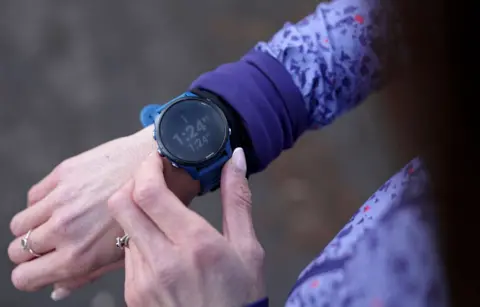
Wait a second. I have to sort my tracker. The same goes for the guy next to me.
The person in the line expresses impatience. I won't start until… done! Connection established, and I'm running.
Amidst the crowd, it's challenging to find a wrist without a wearable on it. And this isn't only us participants who rely on them.
It's a explosive, multi-billion dollar market. Companies like Garmin dominate, each with an extensive array of diverse models to cater to a range of lifestyles. Based on how high tech the device you select, costs can vary between an affordable sum to a significant investment.
"I find it infuriating, I'm unable to switch off."
"It reassures me… It feels like a supporter guiding me."
"Please don't notify me I've experienced a bad night's sleep."
A handful of the comments I've received from like-minded smartwatch wearers when I question what they feel about theirs.
The Data Dilemma
My feelings on my own device? At this moment, irritating. It's telling me I'm off pace, causing me to question whether the trees I'm running below are blocking my satellite signal.
Millions of us attach these compact devices onto our wrists and use them 24/7, seemingly at ease with the fact they're perpetually recording us.
Gone are the days when we depended on them solely to give us an idea of our step count. Today, they can analyse our sleep patterns, stress levels, glucose levels, our body battery.
It's tricky to find a health indicator they don't track.
But are they able to do what they say they do? And are the statistics we analyse a accurate representation of reality? Do they enhance our mental and physical wellbeing, or do the plethora of measurements and cheerleading alerts just contribute to our everyday anxiety?

A Complicated Bond
"I find myself getting a bit obsessed with mine," a wearer reveals.
While she appreciates how her device tracks her workouts, she finds some of its other capabilities "excessive" at times - a feeling initially realised during a significant period.
Before she realised she could put it into a specific mode, her smartwatch repeatedly informed her she was being insufficiently productive enough. In a new phase, the watch keeps telling her she's had a bad night's sleep.
"I've got a young baby, it's unnecessary for me to be notified I've not slept," she says. "I know that only too well."
Is it not possible to just stop wearing it?
"I suppose I could, perhaps, but I have this complicated dynamic with it," she continues. "I love it for its exercise data, I sometimes question whether all the other things it can now do is maybe excessive for me."
Inside the Device
Each model of smartwatch has its own proprietary way of monitoring your health metrics and analysing your data, but the vast bulk use optical sensors on the back of the watch.
They typically emit minute LED lights onto your wrist which can observe pulsation, recording your pulse rate. More advanced devices measure changes in the skin conductance that passes over the skin to get an idea of your recovery state.
Expert Perspectives
A professor says that for most people for smartwatches, it's a "fine balance" - while the continuously improving tech could actually save lives, "detecting disease before we feel unwell", it could also turn us device users into the "concerned but fine".
He points out that newer wearables can conduct tests like electrocardiograms (ECGs), which constantly monitor how normal the heart is. They can notify if someone is experiencing an irregular rhythm, where there is abnormal impulses in the heart causing an arrhythmia.
This does not mean someone is on the verge of a cardiac event, but it can give an early warning they might be more susceptible of a heart problem in the future.
But how to understand these numbers is not straightforward. The expert worries that as additional features are introduced, people may struggle to fully understand their data.
"I remain sceptical that being able to monitor so much data is such a positive development," he says.
A professor specialising in patient behaviour agrees. Her work into the influence of wearable tech on a cohort of individuals with health issues suggested a significant portion of those who were given devices to monitor their heart health experienced heightened worry and were "far more likely to use healthcare resources".
She observed a vicious circle with her patients - they spotted a alarming metric on their watch. They grew concerned. Their pulse increased. They got increasingly anxious. They looked a second time, and their heart rate increased again.
"When people are presented with stats about ourselves that we can't properly interpret then, understandably, we are going to seek clarification," the psychologist says. "We check, we check again - it becomes a feedback loop."

